MuSIQoS
Multi-domain Synchronization and Intelligent QoS optimization System
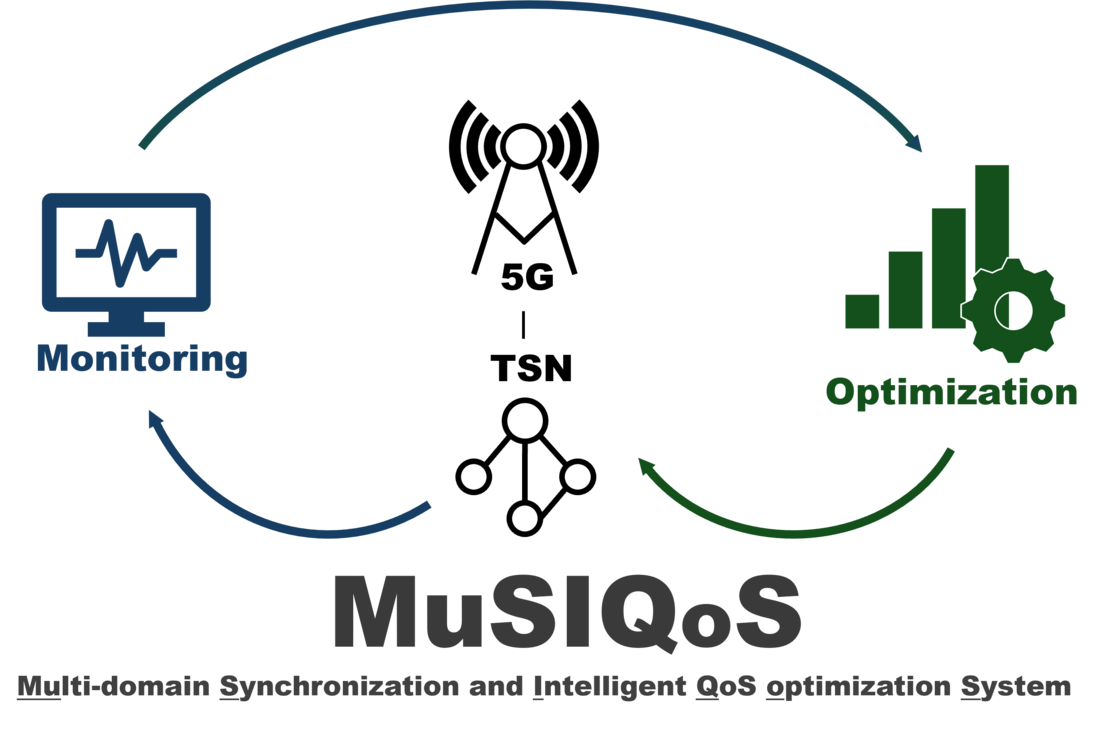
A major challenge for industrial networks is the integration of various network technologies for specific applications. One scenario that has recently become increasingly relevant is the provision of networking solutions for mobile machines, such as robots. In this scenario, the use of wired technologies is no longer feasible. Therefore, the goal is to combine them with a wireless technology to control these machines. In particular, a combination of two networking technologies (5G and TSN) has emerged as a viable solution. However, combining these two technologies is anything but trivial. With the extension of 5G systems to include TSN-5G integration, which is included in the current 3GPP versions, components have been defined that enable the connection of 5G to TSN systems. However, these components are not present in current commercial 5G systems. Modern manufacturing processes in Industry 4.0 have high dynamism with varying wireless environments. This makes it difficult for network management to guarantee the required Quality of Service. The current approaches to static network configuration are not suitable for such dynamic industrial environments. To ensure QoS and QoE during operation, online monitoring of QoS and network resources is required so that, in the event of QoS violations, the network configuration can be adjusted immediately.
The goal of the MuSIQoS project is to research and develop a dynamically configurable 5G-TSN network and to develop QoS monitoring and AI-based analysis tools for the integrated 5G-TSN network, as well as algorithms for configuring it based on the analysis results. To this end, the TSN components in the 5G RAN and core networks—such as the 5G TSN Application Function (TSN-AF) and the TSN translators (DS-TT and NW-TT)—will be developed and optimized based on the 3GPP standard to support TSN over 5G networks in dynamic environments.
To monitor the performance of the network components, a system will be implemented that monitors them and collects the necessary information for identifying bottlenecks. This system filters and classifies the collected data based on the required performance metrics. Based on the collected data, the 5G-TSN network will be dynamically reconfigured to ensure optimal configuration. For demonstration purposes, an integrated 5G-TSN network will be set up and used to control collaborative robots in realistic scenarios.
Duration: 07.2026 – 12.2028 (30 Months)
Consortium: airpuls GmbH (Project Leader) (Berlin, Germany), brown-iposs GmbH (Bonn, Germany), Cumucore Oy (Esbo, Finland), University of Applied Sciences Osnabrück (Osnabrück, Germany), University of Technology Chemnitz (Chemnitz, Germany).
Associate Partners: Siemens AG (Garching, Germany), Maschinenfabrik Bernard Krone GmbH & Co. KG (Spelle, Germany).
Project Funding Agency: Bundesministerium für Wirtschaft und Energie (BMWE – ZIM).
Funding amount for University of Applied Sciences Osnabrück: 279,999 €.